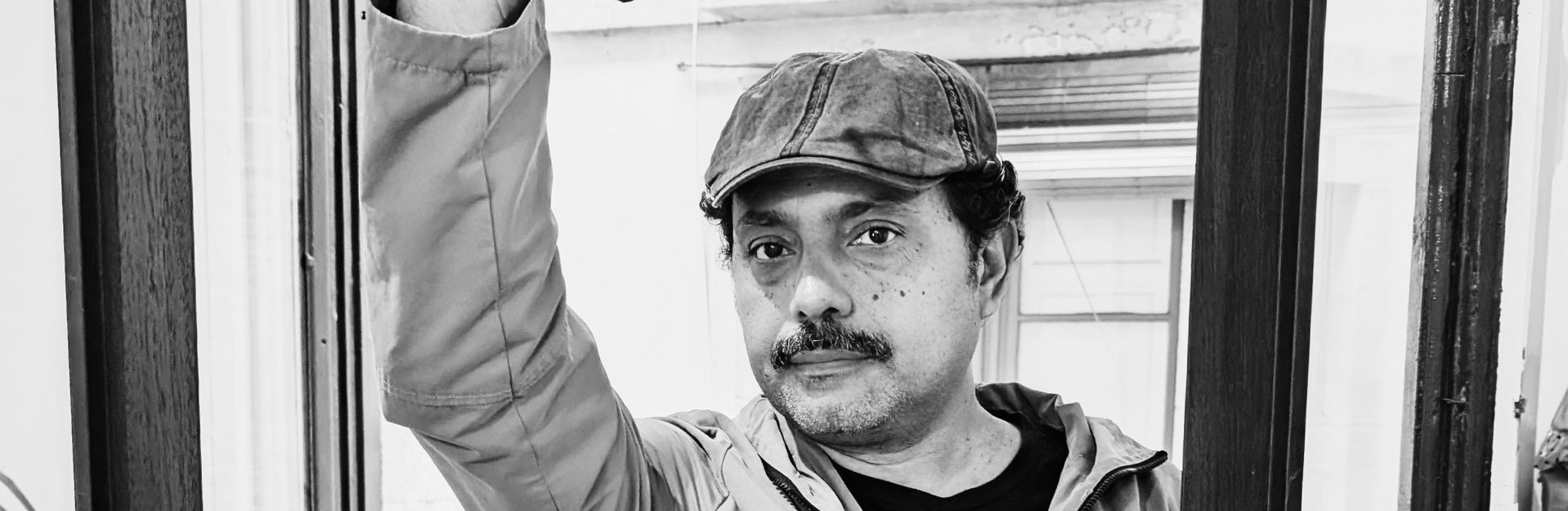
João Fábio Cabral (Rio Grande do Norte, Brazil, 1973) is a Brazilian artist and researcher based in Barcelona. His artistic practice spans painting, performance, installation, video, literature, theatre and film. As a playwright, director, actor and visual artist, he has developed an artistic language shaped by territorial tensions, class relations, racism, LGBTQIAPN+phobia, sexism, and existential and political questions. Over the years, his work has evolved not around fixed disciplines but through crossings between artistic languages. Between body, space and atmosphere, his practice unfolds within transdisciplinary spaces, where the boundaries between artistic languages become permeable and artistic creation emerges as an experience of passage, friction and risk.
Currently a PhD candidate in Artistic Creation at the University of Aveiro (Portugal), where he is conducting research titled ESTUFA SOCIAL (Social Greenhouse), a transdisciplinary artistic project investigating the potential of plastic as a material and sensory device of systemic oppression. The project examines contemporary mechanisms of control, conditioning, and the erasure of bodies. As part of this investigation, he has developed the concept of Arte-Passagem, understood as an artistic practice grounded in the experience of passage, rejecting repetition, predetermined scripts and formal stability. Within this trajectory, performances such as ‘Oppression in Sculpture’, ‘The Name of the Plasticized Body’, ‘Art-Passage’, ‘Around, Between and Beyond’, and ‘Estufa Social – O.S.’ have emerged. His practice operates in a continuous state of displacement, where body, action, environment and materiality become inseparable elements of the creative process.
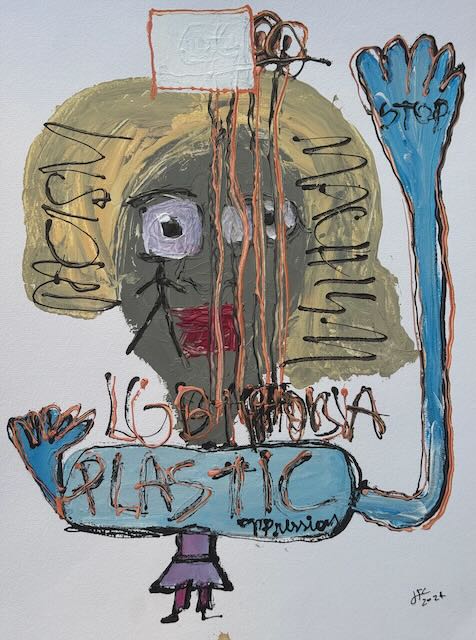
In the visual arts, Cabral’s paintings reject the canonized body, opting instead to depict forms that subvert traditional ideals of perfection. Incomplete faces, distorted figures, fragmented and mended bodies run through the series Corpo-Retalhos, where desire, disappearance, emotional precariousness and survival coexist within the same pictorial surface.
He holds a Master’s degree in Theatre Directing from the Escola Superior de Teatro e Cinema in Lisbon (2018) and trained at the Ewerton de Castro Theatre School in São Paulo (1999). As a playwright, he has written more than fifty plays, over forty of which have been staged in Brazil, Portugal and Spain. In 2013, he published Cinzeiro – 17 Plays de João Fábio Cabral (NVersos), a volume bringing together part of his dramatic output.
É fundador da AMesMa Cia, ao lado de Andreia Garcia, Vinicius Calamari, Lê Fazzio, Laura Salvatore, Clodd Dias, Cleyton Nascimento, Alice Stamato, Sheyla Makeda, Shalana Costa, Danielli Guerreiro e Giovana Quinto, realizando trabalhos como Bob e Negro, Cidade Silenciosa, Algumas Laranjas e Janeiro. Ainda escreveu e dirigiu espetáculos como Tanto, Aguardo Notícias da Polônia, Monólogos Sobre Você Enquanto o Horror Mastiga Flores, Eu Não Sou Daqui, Casulo Bárbaro, Border Body e, agora, Estufa Social. Como ator, integrou projetos no teatro e no cinema, participando de filmes como Jonas (2016), A Busca (2013) e Getsêmani (2011). Também assinou roteiros de trabalhos audiovisuais como Darluz (2009), Lugar pra Ninguém (2016), Casa de Família (2020) e Habitación (2021).
During the COVID-19 pandemic, he wrote "Hell Has No Pillow", a series addressing femicide and violence against women, and co-directed, together with Andreia Garcia, episodes filmed in São Paulo, Los Angeles, New York, Natal, Lisbon, Barcelona, Curitiba, Salgueiro and Paris.
His career includes the creation of Cia Café Poesia, a theatre company of adolescents alongside Fausto Brunini, Fabiana Carlucci, Vander de Sousa, Camila Grazzano, Maurício de Barros, Thaís Barros and Roberta Soares. He co-founded Espaço Cultural Fuá, together with Fabiana Carlucci and Rogério Harmitt (São Paulo, 2011–2012), a cultural space that brought together theatre, music, visual arts, poetry and performance. Cabral also originated Leitura de Boteco, an initiative in São Paulo devoted to public readings of theatrical texts in bars.
Currently, alongside the development of ESTUFA SOCIAL and the Corpo-Retalhos series, he is writing his first novel, a work that interweaves displacement, fictional autobiography, non-belonging, loneliness and social critique as an extension of the same artistic exploration of what it means to exist as a contemporary body.
